• Oysters & Puppies & Good times


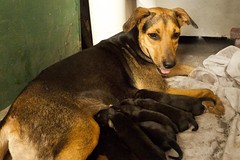
    Shakira & her pups
    Originally uploaded by apes_abroad.

    A couple days ago Colin and I went out with Don and his friend John on an oyster hunt. We crossed the estuary and walked over the rocks on the point to find a place we could enter the water without being chewed up by the waves. It was a low visibility day so we had to dive down to see the rocky floor and searched for crevices in the rocks where a little black slit of a mouth might be hiding. It took me nearly half an hour to finally bag my first one and I shot to the surface holding it high and singing the A-Team theme through my snorkel.

    I found my second and third by turning over rocks, and in the process also uncovered eels, slugs, and a beautiful big cowrie whose shell was at first totally covered by its bumpy grey body. Then came the biggest, most tenacious oyster which all my tugging could not separate from the rock. The current was picking up as the tide came in, so every time I had to come up for breath I was afraid I wouldn’t be able to find him again. My fingers got all cut up in the fierce battle, but after five tries I shot to the surface holding the oyster over my head in victory!

    That night we had ‘pirates’ at the bar, which is an oyster with chili followed by a shot of rum. When I lifted my oyster to my lips (my tenacious opponent perhaps!) I saw a tiny pair of eyes looking back at me. The oyster had been home to a miniature transparent lobster, smaller than a thumbnail with perfect little lobster claws and wavy eye stalks. People eat these guys live as a delicacy that kind of tastes like sweet fish roe (Aaron ate one while he was here!) but I couldn’t do it. A friend took pity and brought it down to the ocean, where I doubt it will be able to find another oyster (I now know from experience, they’re hard to find!) but one can hope.

    While the Mishkins were here we were all placing bets on when the local dog Shakira would give birth. Well, she looked ready to pop for the last two weeks I thought, but Ariel won the bet – she gave birth within 24 hours after they left. Gabe’s wife Natalia had to crawl down under the bar floor to retrieve the puppies. Four.. five… wait there’s two more.. eight.. oh there’s even more over here.. ten.. eleven! How Shakira, who was not a very big dog, fit eleven puppies in her I don’t know, but she is much happier now to have them on the outside (she could hardly walk before!).

    The puppies still haven’t opened their eyes and only have two states: sleeping and hungry. For me they are right on the gross/cute line but quickly tipping over to cute. You can see what I mean in this short video I took of them piling on Shakira to feed.

  • Pochote to Montezuma in four hours


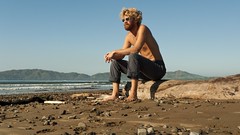
    Rock shop beach
    Originally uploaded by apes_abroad.

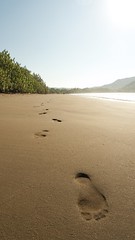
    Looks like I forgot to record our epic stroll to Montezuma, although you may have seen the pictures on Flickr. We’d previously made it as far as the lone “Jesus” tree with Don before the tide cut us off, but on our second attempt we had the timing perfect. We started out after a hearty breakfast of gallo pinto and egg, and made the first hour along our beach before the sun was too high and hot. In Tambor we tried to recruit some guys who’d been keen on the idea at Neisy’s birthday party the day before, but they were all talk so it was just me and Colin, Don, Riley’s girlfriend Pauline and her friend Tom.

    From Tambor to the Jesus tree on the point is a nice shady stroll, then you head out over some rocks, then along a stunning white sand beach, then over some rocks and another beautiful empty beach. We were mostly following the old road, which used to be the only way to get from Tambor to Montezuma before they build the inland road. People still used it to get beach access for camping and picnics, although we met very few people on the trail. The sun rose and it got hot going over the rocky points and we were glad for the breeze and the cool shady bits.

    Don was usually out front setting the pace. I hung back a bit and chatted with Pauline and Tom in French, which was refreshing after all the trouble I’ve been having with Spanish. It got me and Colin to thinking of where we might go next that we could practice French and live on the beach – well why not French Polynesia? They seem to have been hit hard by the recession so we found a great deal on the island of Moorea just off Tahiti. The next time we saw Tom, Colin noticed he was wearing a Moorea t-shirt, because it turns out he grew up there! Coincidence, or subliminal messaging?? Anyway he has given us all kinds of hints, contacts, and a map of his favorite spots.

    About midway through our walk was a long stretch of black rock, and we were all getting pretty hot. Up ahead, we heard running water. It was the waterfall! We scrambled faster to get up to it, a perfect cascade of water coming over the cliffs that at high tide would plunge into the ocean. We sat under it for nearly ten minutes, cooling our faces under the torrent of clear cold water and filling up our bottles for the second half of the journey. Don carried no water; he just filled up like a camel before we left and he did so again here.

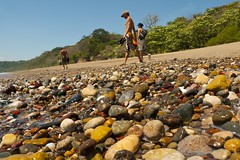
    After that we walked along the most interesting beaches: two of them had drifts of perfectly smooth stones in candy-like colors of red, yellow, blue, green. Another had piles and piles of perfect shells, mostly olive snails which I guess the hermit crabs have trouble getting into. We started to meet other people on the trail as we neared Montezuma. Some sort of bicycling event rode past us, thirty or more of them looking hot and exhausted, accompanied by cameras and water trucks. The sun had passed overhead and we were starting to flag, hungry and hot and stiff. We stopped at one last deliciously cool swimming hole and I could feel the heat radiating off me as I lay facedown in the water for as long as I could hold my breath.

    Just around the corner was our destination – Montezuma! We collapsed into chairs at a beachside sushi restaurant for the most delicious food I’d had in weeks (Colin reminds me that hunger is the best spice). Then we tottered around the little touristy beach town for a bit and caught the 2:something bus back to Pochote.

    Quel journeé!

  • La visita de mi familia


    Aunt Diane and the Falls
    Originally uploaded by apes_abroad.

    Last week was our long-awaited visit from the Mishkins! Colin’s aunt Diane and our cousins Ariel and Aaron came all the way from Nanaimo, BC to hang out with us in beautiful Costa Rica. Colin flew up to San Jose to meet them and help with the process of getting a car and navigating the four hour drive over to the Nicoya Penninsula and our house in Pochote. They stopped at a zoo near Alajuela and saw all sorts of rare local animals from ocelots to alligators. First order on arrival was a walk on the beach (the first of many) followed by roast chicken at Gabe’s place (also the first of many).

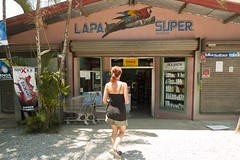
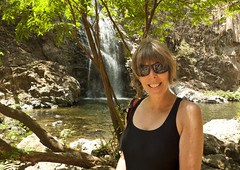
    For the last five weeks we’d been making do sans vehicle, bumming rides off our kind neighbors and walking to the Super Lapa Grocery at the other end of the bay. With the rental car we were eager to get out to see other towns and nearby reservas and refugios. We drove down to the cute surf town of Montezuma (which we’d previously seen at the end of our 4 hour beach hike) and checked out the waterfalls and Cabo Blanco reserve. Colin had a bit of a headache (understatement!) but he pulled through and we finally had our first encounter with the howler monkeys that we’d been hearing for the last 2 months. Sitting in trees, they look quite a lot like big black termite nests, but it’s easy to tell the difference once they start hooting. Later we walked up to a nice little swimming spot at the base of a waterfall. Colin and a local guide dove off high things together (the pool was small but 10m deep!), and I found a nice spot to sit right under the falls.

    We continued our daily routine of walking down to the river to skim and swim, now with Aaron on the skim board and Ariel with me in the water. Even Diane tried bodysurfing! We took them over to the Playa de los Muertos one day to go snorkeling. Crossing the estuary was a challenge at high tide, but Ariel works as a lifeguard and was able to swim across with our food above her head, not getting it even a drop wet. On the way back we met a family of howler monkeys on the hill and stopped to watch them crossing in the trees above. It was an amazing experience seeing them right here in Pochote and knowing that these are probably the same monkeys we hear every morning.

    On their last day we drove up to the Refugio Curu near Paquera. It’s a hotel as well as a wildlife park so I was prepared for tourists and plasticness, but there was none of that. We took the lovely low trail that goes from beach, through mangroves, across a rickety wooden suspension bridge, into the dry jungle for quite a ways, then through an overgrown mango plantation that has been left to the monkeys. We saw all sorts of wildlife: orange crabs licking their sand balls, lazy iguanas, skittish brown lizards with and without their tails, a huge inland hermit crab, a skunk, white-tailed deer (you’d think you were in Nanaimo!), snakes, “Jesus Christ – lizards!” (they run on water, and yes you have to pronounce it that way), howler monkeys, white faced capuchin monkeys, rehabilitating spider monkeys and a nasty goat that stunk of urine.

    I should explain the last few. They had a rehabilitation pen where spider monkeys that had previously been pets and were being prepared for release into the wild. One of them ran right to us when we arrived and stuck his arm through the bars. I held his hand and he gazed at me as if to say “I can’t take it in here – call my lawyer, you have to get me out of here!”. Then this horrible reeking goat (the prison guard, I think) chased the monkey off to the other end of the pen. The other monkeys just looked on in silence, fearing solitary should they step out of line.

    The best part though was the capuchin monkeys (as seen on Friends), which unfortunately only Colin and I got to see. A big family of 20 or so were hanging out in the mango trees chewing on fruit and bean pods and for some reason breaking off all the sticks (gardening?). There were little babies and bouncy teenagers and we abandoned the path to get as close as we could. Eventually one of the males got sick of our presence and went all monkey-aggro, baring his fangs at us with his butt all up in the air. I bravely snapped pictures until a second one picked up the stance then I booked it. Scary monkeys! Turns out they wanted us to back off so they could cross the road and head over to the other side of the river. One of them followed us and sat over our heads as guard, while the rest of them crossed through the trees with some amazing leaps (and some misses).

    They headed off to check out an active volcano before flying back to BC. I can’t believe it was over so fast! I had such a great time with the three of them. Cooking and making smoothies, swimming and kayaking and hiking and walking on the beach. We were so happy to finally be able to share our little corner of paradise.

  • Talkin ’bout SpaceChem

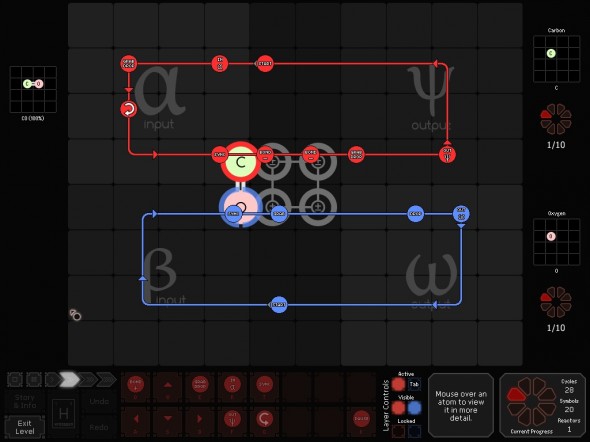
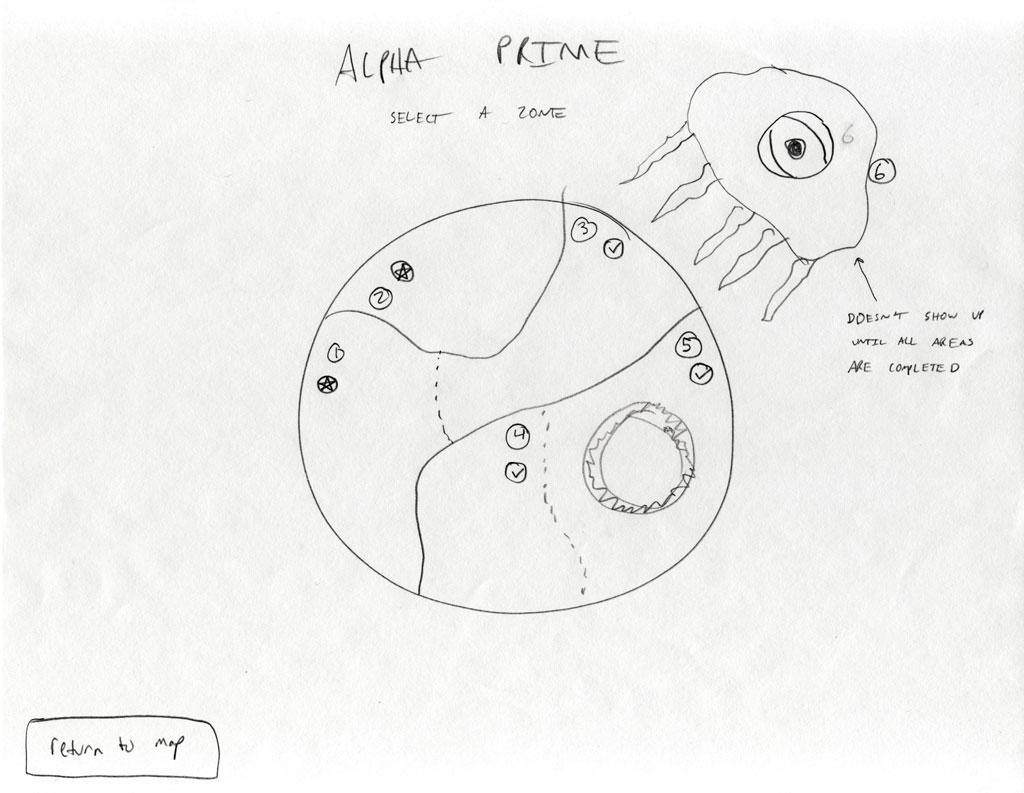
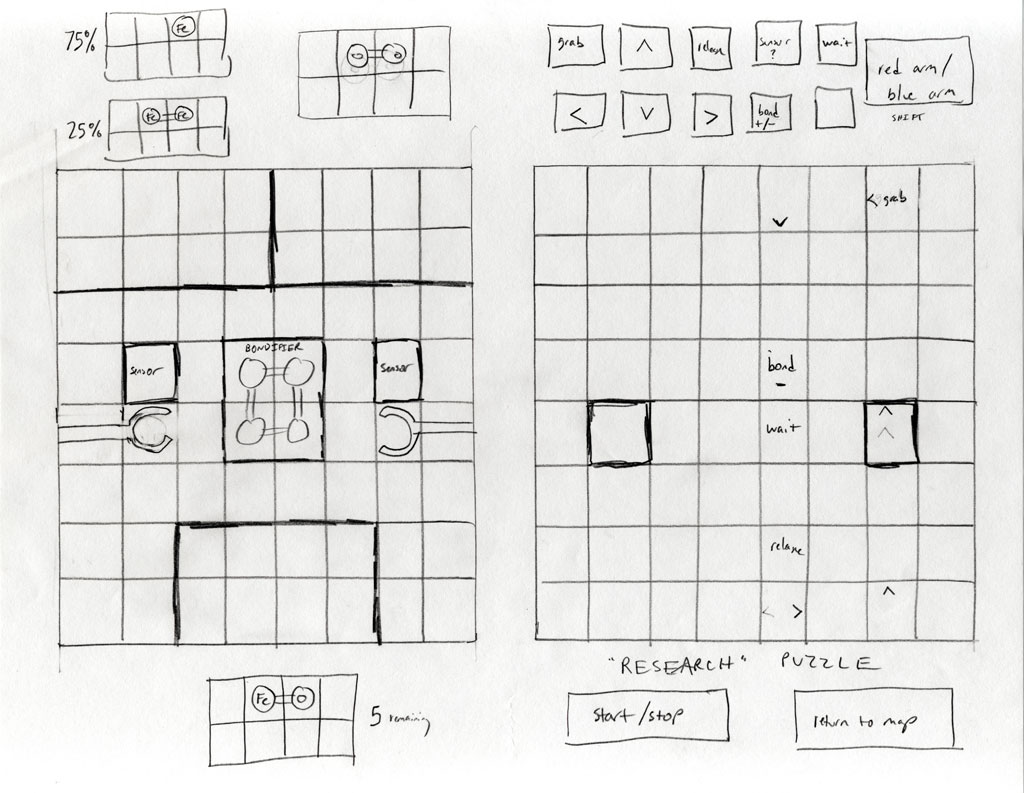
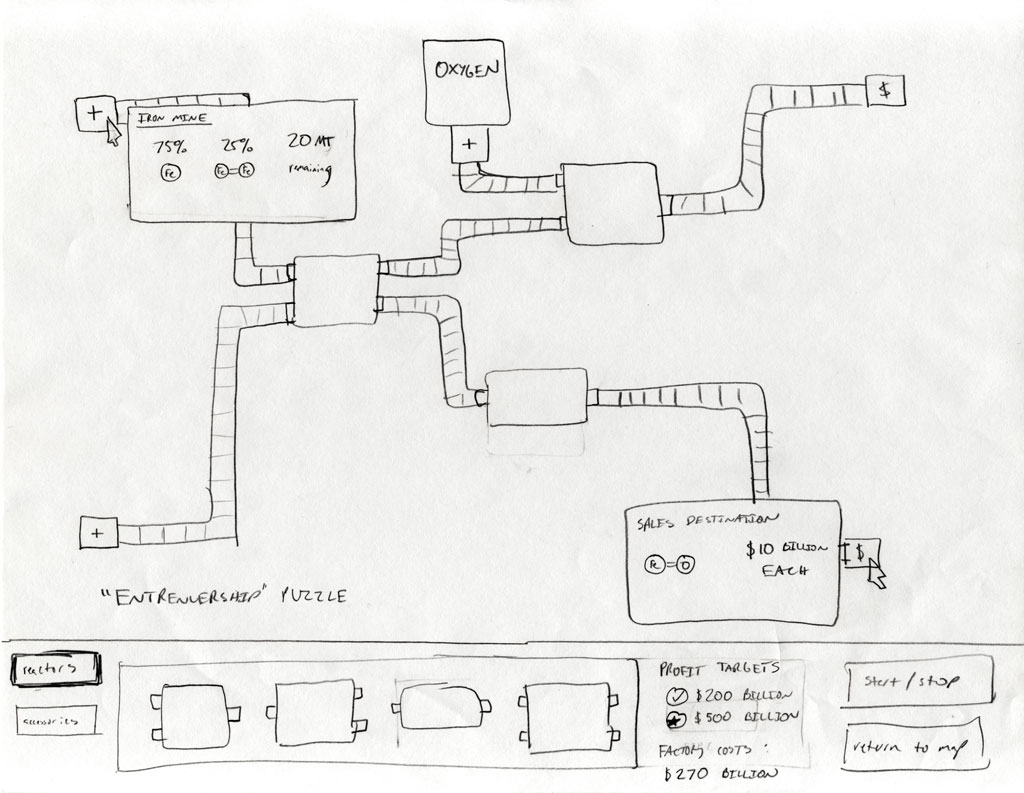
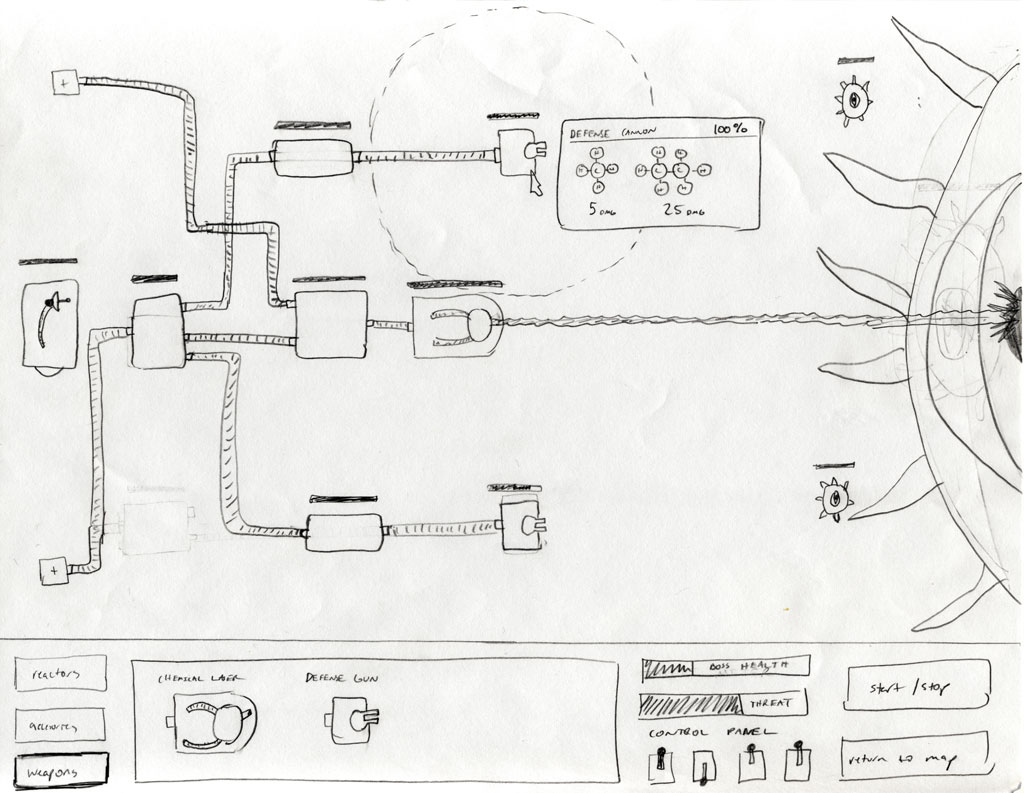
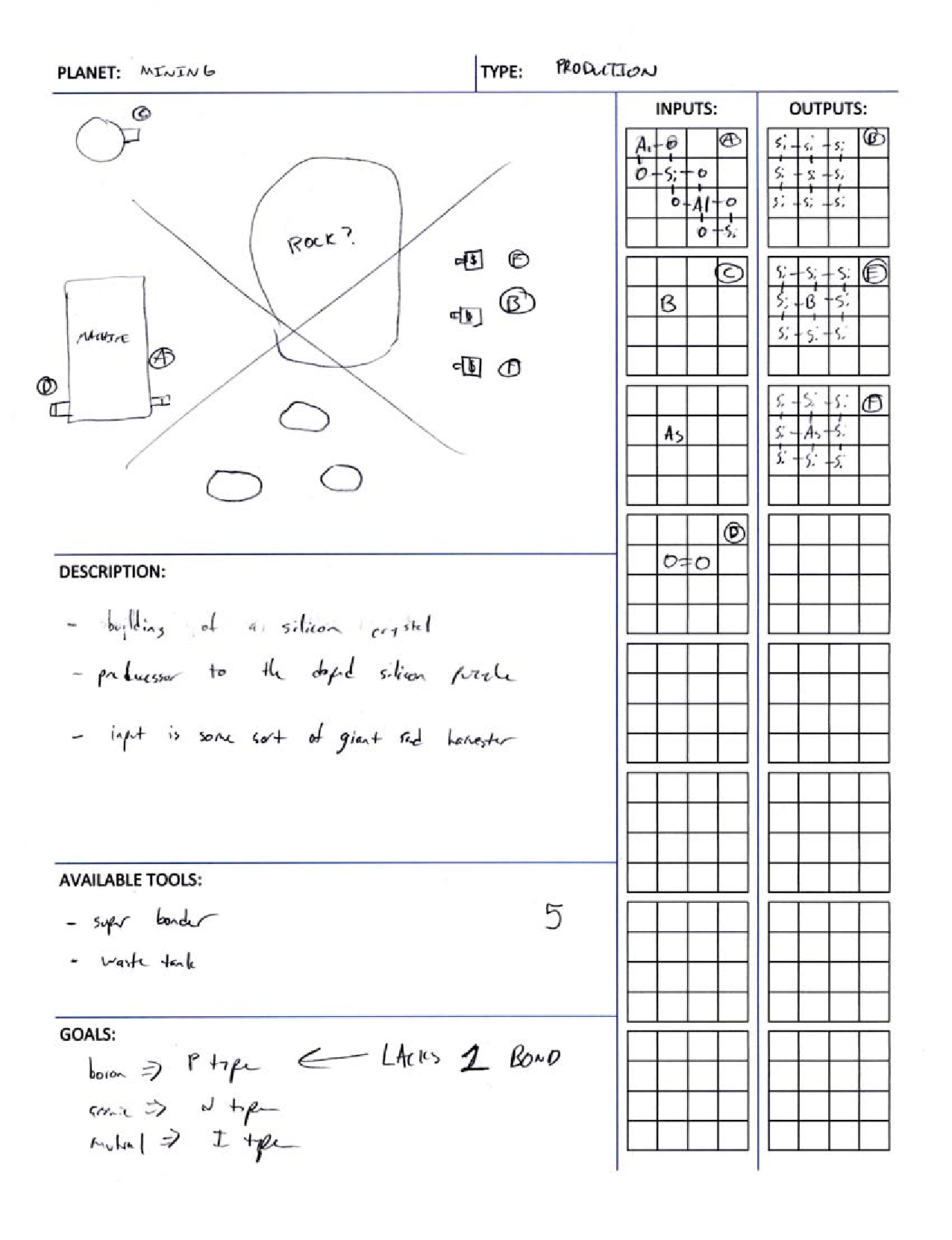
    I’ve mentioned before that I am a massive SpaceChem fan. Whenever I’m playing a great game I can’t help but wonder about the process that brought it about so I decided to contact Zach Barth, the designer of SpaceChem, and ask him a few questions. During the interview he was also nice enough to pass along some very early design sketches which I’ve included in the article.


    Colin: How did you start working on SpaceChem?

    Zach: I started working on SpaceChem in November of 2009 with a friend who, being familiar with my previous works, wanted to make a game. Over the next year we picked up another programmer, a musician, an artist, a writer, and a sound designer. My goal for the project was to up the scope an order of magnitude from my previous games. There were plenty of times when it felt impossible, but with the help of my team we nailed it in the end.

    Playing through those previous games you can see ideas evolve from game to game. The Codex of Alchemical Engineering obviously had a strong influence on SpaceChem. When you started SpaceChem what did you want to keep from The Codex and what did you want to change?

    While I wanted to keep the mechanic of building structures out of “atoms” by “bonding” them together, I also wanted to add a bunch of new ideas that came to me after releasing The Codex, such as inputs being more complicated than a single “atom” and a greater context for the puzzles. I also made sure to fix some of the glaring gameplay errors, such as requiring structures to be built exactly as shown and having the complexity of solutions ramp up exponentially.

    Are there other games in the back-catalogue that had a big impact on SpaceChem?

    The defense missions are very similar to the battles in The Bureau of Steam Engineering, as they both require players to build a mechanism to power massive weapons with timing and sequencing requirements.

    I found that idea interesting because of its contents and because of my familiarity with it. This is a bit of trend with all of my mechanics: I invent a new problem in the form of a new game and use both brand new ideas and lessons learned from previous games to solve it.

    A lot of indipendent game authors take a very iterative aproach to design. Do you work in the same way or do you plan things out from the beginning?

    A mixture, really. I started designing SpaceChem by drawing up initial concepts for mechanics, progression, interface, story, and almost every other aspect. After that we wrote a prototype to test out the reactor mechanics and then began working on the full game.

    Over the development cycle, though, we changed many details as we learned what worked and what didn’t. For example, pipelines were originally based around an economic model that rewarded efficiency and allowed you to either “pass” or “master” the level depending on how many constraints you were able to optimize for. You could place as many reactors as you wanted and discard as many molecules as you needed to, but in order to “master” the level you’d have to balance the number of reactors against the number of products you chose to produce and maybe not throw away any molecules.

    Although I’m sure some of our hardcore fans will think we were stupid for throwing this system away, early playtesting indicated this was far too confusing. After a bit of discussion we vastly simplified the system to a single binary goal of “produce all compounds using the number of reactors allowed and generating waste only if the level includes a recycler”.

    How much impact did the rest of the team have on the design of SpaceChem?

    Although I was essentially the “gatekeeper” of design, many of the decisions were made as a group, to the point that I can’t even identify who was responsible for what ideas.

    How long did you spend on the initial design phase when you were drawing things up?

    The initial design phase consisted of a year of spare moments and snippets of conversations that birthed ideas that would go on to make SpaceChem and about two weeks of sketching and discussion when we decided to get down to it. I sketched out most of the design not related to the core mechanics while prototyping was being done by Collin, the aforementioned initial programmer friend.

    In prototyping we found that the core ideas could work, but not much more, as the prototype only encompassed the core reactor mechanics and lacked critical touches such as the line drawing and reconfigurable bonders (they were originally all 2×2). As mentioned earlier, a lot of the little decisions about how to make everything fit together nicely were made incrementally.

    When it comes time to do design, my primary tool is sketching, which forces me to fill in the gaps in ideas that exist only in my imagination and allows me to visually inspect the finished product and imagine how it will function. In the early design sketches you’ll see the cut features I mentioned earlier: pass/master goals, an economic model, and tower-defense style defense missions.

    Now that it’s out the internet is peppered with glowing reviews for SpaceChem. I’m a huge fan of the game myself and I’m proud to say I’ve finished every level. The final level alone took me 10 hours to solve though. Were you not worried that the game requires too much stamina and prolonged intense focus? Is SpaceChem written for a specific audience?

    This was definitely a question that was on my mind, but more truthfully it was something we had very little information about. Some of my previous games were similar to SpaceChem, but were both free and short; we had no idea how players would respond to a scaled up version, let alone what would be the best way to broaden the scope.

    SpaceChem wasn’t written with any specific audience in mind, and from what I can tell it hasn’t resonated with any one audience in particular. I’ve read an astonishing number of players remark that they normally don’t like puzzle games, but that they can’t stop playing SpaceChem!

    Most important question for last: when are you finally going to write Ruckingenur III?

    Hah! Ruckingenur II is by far one of my favorite projects – it’s just so sexy! The puzzles were really difficult to make and had zero replay value, though, which in addition to the inherent niche-appeal makes me think that a sequel isn’t likely. I hope to explore the general concept more in the future, though


    Thanks very much to Zach for answering some questions about how he and his team designed a great game. You can buy SpaceChem on SpaceChemTheGame.com or on Steam and you can play Zach’s back catalogue of games (including the really excelent Ruckingenur II) at ZachtronicsIndustries.com.

  • Rebuild: selling a Flash game on FlashGameLicense

    FlashGameLicense is as far as I know the only Flash broker out there and is used by every Flash game sponsor, so it’s amazing that despite their monopoly they’re working so hard to improve it all the time. When I uploaded Rebuild I got great feedback from the FGL admins who play every game before it’s allowed up for bidding. They were really enthusiastic and helped personally through the bidding process, so I was happy to pay their 10% commission – they really do deserve it.

    FlashGameLicense sale data
    Most games on FGL sell for under $1000

    Of course, FGL doesn’t come through for everyone. The average winning bid for primary sponsorship is under $1000, usually for things like dressup or seasonal games that sponsors can easily judge the value of because they’ve seen them a thousand times before. Colin tried to find a sponsor for Fantastic Contraption through FGL, but the best he got was an offer of $300 for full ownership of the source (try 1,000 times that, asshole). This was three years ago and FGL has improved their content discovery tools, but it’s still hard for sponsors to know if a confusing, wordy game like Rebuild is going to be popular.

    I’m not at liberty to give you exact numbers (visit Andy Moore’s blog for that) but here’s how Rebuild’s bidding went on FGL. It started out with a bang, a higher-than-average-sale bid from a fellow developer looking to promote his Zombie-themed MMO by featuring it on other games’ loading screens. In my opinion a pretty cool way to simultaneously advertise and support other developers. Three other sponsors I’d never heard of joined in and by the end of the second day I’d made my minimum wage.

    Jay Is Games Review
    Launch day review on Jay is Games!

    Someone put a bid in for a sitelock, which is a secondary sale made after primary sponsorship. You create a version of your game locked to one domain, stripping out ads and primary sponsor logos and implementing the secondary sponsor’s high scores api. It was early, but they were letting me know they were interested no matter who won the primary bid. JayIsGames contacted me to say they wanted to review the game when it came out. This is my go-to site for casual games so I was pretty stoked! I got excited about how fast things were happening and pulled in some contacts to invite the other major sponsors to take a look.

    Then I heard nothing – no bids – for five days.

    At this point there were two highest bids for the same amount with different contract terms. One of them included ads and extra work, so I contacted that bidder and told them that I was favoring the other offer. Bidding sprang to life again! I still hadn’t seen hide nor hair of any big sponsors, but the guys who were bidding seemed to personally like my game and were willing to go above budget for it.

    From then on, every time bidding stalled I messaged the runner-up again to let them know that, although I really liked them and their bid was great, the other offer was a little better. I gave a specific dollar amount they’d have to put in to beat it. I think I would have missed out on a lot of bids if I hadn’t done this. We were well into the holidays at this point but I got bids even on Christmas day (a marvelous present!).

    Two Towers Games logo
    Zombie-themed splash screen for Rebuild

    Until then the offers had been for primary licenses with additional work requirements (apis, new features, etc which were increasing in complexity as the bids went up). Two Towers Games asked about switching to exclusive, which meant I wouldn’t be able to sell sitelock versions to other sponsors. Implementing sitelock apis seemed like effort I could be spending on my next game instead, so I agreed. Their winning bid went in 20 days after bidding started and sat for another week before I accepted it. Again, I can’t tell you how much it sold for, but I will say it brought me into the FGL top-sellers list.

    My sponsor Two Towers was new on the scene, and the exclusive license gave them more time and control over Rebuild’s release and traffic. I was a little dismayed to find I’d agreed to implement ads (this is standard in most licenses) but we agreed there’d be none in the Kongregate version which was what I really cared about. It took about a week to make all the necessary changes for launch.

    Ads in Spanish
    The only CPMStar ad in Central America

    Rebuild spent the first month live only on twotowersgames.com, then I uploaded versions to Kongregate and Newgrounds and it began to make its rounds on the internet. Two Towers devised a cunning system of dynamically showing content based on a call to their servers, which lets them control on the fly which sites see ads or bonus content. I was also able to sell a few sitelocks with their approval, so long as their branding stayed on.

    For reasons that I don’t fully understand, Rebuild shot to the top of the Kong rankings, won the weekly and monthly contests and after one month is still the #3 highest ranked game with 1.5M plays.

    I’ve gotten hundreds of emails and pms with suggestions for the sequel which I’m eager to get started on, but first I need to finish the game I started during bidding: Word Up Dog. I’ll try to post updates here on the progress of both games.