• Confusing Good with Respected

    Taste’s of a King

    Human beings are relentlessly status seeking, and we are voracious consumers of novelty. These two things combine in weird ways when people talk about art.

    You hear people leaving movie theatres saying bizarre things like “Yeah I really liked that movie but I wouldn’t consider it Good”. This is madness! Clearly if you enjoy a thing then that thing is good, that’s the best definition of “good” that I can think of.

    But there are cases when you would be wise to couch your praise for fear of seeming a rube! We are all always, subconsciously, attempting to raise other’s opinion of us on pretty much every topic imaginable and when we can’t do it honestly we fake it. That’s why you didn’t ask the teacher questions in high-school if you were truly lost (unless you were confident that everyone else was also lost).

    This means we all want to have “sophisticated” tastes in movies, painting, wine, music, games, everything. But what is “sophisticated” is what is liked by the medium’s Ultra Fans. People who devote all their spare time, or even their lives, to a topic. I am a games Ultra Fan, but I am not a wine or music Ultra Fan and hence I behave oddly around wine and music. I have actually caught myself looking up reviews for an album before suggesting it to a friend lest my taste turn out to be “incorrect”. I am very uncomfortable at wine-tastings because of the chance that my lack of wine-sophistication will be uncovered, even though it’s totally normal to not know anything about wine!

    It’s also why people have “guilty pleasures”, songs they listen to in their headphones but don’t want people to know they like because the song is beneath their tastes.

    There are times where you will profess ignorance and things I profess a proud ignorance of, like cars and sports, but that’s also status seeking “oh cars? I enjoy more intellectual pursuits thank you”.

    A lot of the time we are trying to seem as sophisticated as possible, which is always more sophisticated than you actually are, so we deny our love of things that we think an Ultra Fan might not like. Ultra Fans used to like summer blockbusters, they were 13 once, and loved them (maybe only secretly) but the price of our voracious lust for novelty is that Ultra Fans get bored. They’ve seen a lot of action movies, rom-coms, slashers, and those movies have lost their novelty. So the best way to seem like an Ultra Fan is to think something is boring. To fake cool your default stance on everything should be boredom, because no matter how good something is you can always claim you’re above it.

    This is offset by people wanting to gush about things they actually genuinely enjoy hence the “I liked it but I wouldn’t say it was a Good movie”. Simultaneously expressing your joy and couching it lest someone think you are unsophisticated.

    We do the reverse sometimes and say something is “wonderful” if we think an Ultra Fan would like it, which is why total nonsense can be highly praised. If you don’t understand it then it must be for a more sophisticated audience than you and by praising it you appear to be part of that audience.

    I was going to end this with a whole paragraph defending myself from accusations of extreme vanity, but that would just be more status seeking. I’ll let you decide for yourself, just as you should with whatever movie you watch next or game you play. If you like it, just say so.

  • How Does a Good Game Start?

    I’ve spent the last two years working on Incredipede and I’m finally about done with it. That means I get to enter that wonderful world of prototyping! Not having a game to work on is the best because looking for a game to work on is super fun, except for the parts that suck. The part that sucks the most is having a new idea and not knowing if it’s any good. To close this knowledge gap I wrote some designers I know who have had success to find out how to tell if your prototype is any good.

    There are a lot of game ideas out there and it’s not obvious which ones are going to be fun. I have a file on my desktop called gameIdeas.txt which is a list of over 40 ideas ranging from “One button game: afghan kite fighting” to “knitting!…?”. Picking which game to start is easy, which one makes your mouth salivate the most? Picking when to give up on it is much much harder for me. Even when a game isn’t fun after months of work and exploring I still feel like just one change, one decision, could make it great. On the other hand, the only two of my prototypes that have worked out and been fun enough to finish were fun right from the start. Fantastic Contraption and Incredipede were both fun (for me) almost immediately and Sarah’s games, Rebuild and Word Up Dog, were fun right away. Is that a general rule? I wrote a psudo-random collection of eight games designers I know to try to find out.

    I wanted to know if their successful game was fun right away, I figure if all successful games are fun right away then I can skip the months of grinding on ideas that seem promising but just aren’t working out. So without further ado, here is the data:

    Derek Yu, Spelunky

    Was it fun right away? Yes

    “Spelunky was honestly the smoothest development I’ve ever had”


    Justin Ma, FTL

    Was it fun right away? No

    “We felt the idea (which was very abstract) could be fun but the actual prototypes were not enjoyable for months.  We could see hints of interesting gameplay but it wasn’t really fun for a long time.”


    Jonathan Blow, Braid/The Witness

    Were they fun right away? Yes

    “Braid was fun in the first week. The Witness probably took 2-3 weeks, if only because it is 3D”

    “I do think this depends on one’s level of design experience, though. Part of being a good designer is being able to just home in on what is really good, without having to spend a lot of time slogging through mud.”


    Jan Willem Nijman/Rami Ismail, Radical Fishing

    Was it fun right away? Yes

    “At Vlambeer, most games come together within a few days. If they’re fun, we work on them for a few weeks. If they’re fun to work on for a few weeks, we turn them into a project (or not).”


    Dan Cook, Triple Town/Leap Day

    Was it fun right away? No

    “Of the prototypes I’m working on now, I’d say that the best ones convert over a few weeks and then we really know we have something fun after 2-4 months.”


    Marc ten Bosch, Miegakure

    Was it fun right away? Yes

    “Miegakure was the third prototype in a series of ‘games in higher dimensions’ prototypes. Ignoring the first two prototypes, Miegakure is incredibly similar to its original vision”


    Michael Boxleiter/Greg Wohlwend, Solipskier/Gasketball

    Were they fun right away? Solipskier: Yes, Gasketball No

    “I do think it’s important to get something down that’s interesting as soon as possible, something that you can play over and over, but there are a lot of games that I would never be able to make if it had to be fun in a few days or a week.  It’s really hard to gauge early on, and I don’t really have any good rules even now.”

    Mike also mentioned that most games he’s worked on have been fun right away with a few exceptions.


    Cactus/Dennis Wedin, Hotline Miami

    Was it fun right away? Yes

    “It was fun straight away from when the basic gameplay had taken shape, which took less than a week.”

    So 5.5 out of 8 replies were “it’s fun right away”. Clearly not every successful game is fun in the first week but a lot of them are. And if you can make a great game without months of smashing your fists against the wall then why not! I like that Vlambeer has gone so far as to build this into their process, judging games by how quickly they become fun rather than how fun they might be down the road. Marc’s aproach of exploring the same design space with totaly new games is also very appealing. If I want to make “knitting!…?” it makes sense to try a bunch of disparate ideas in the design space instead of settling down with one and trying to force it to work.

    FTL and Dan Cook are the counter-examples, and they are strong counter-examples. FTL won the Excellence in Design Award at GDC this year and I personally respect Dan Cook as a game designer more than just about anyone (Leapday is totally amazing). Standing opposite to Vlambeer, Dan has built the months-long search into his process and the resulting games speak for themselves. Clearly you can make great games by taking a rough idea and through teasing, exploring, and experimenting make it into something wonderful.

    But that’s the thing, all that teasing… I hate stressing about whether I should keep working on a “promising” project or whether I’m groping in a blind alley. The fun-right-away rule takes away that stress entirely and maintains a good chance of finding a great game. It’s the way I’m going to prototype my next game. It’s all dim sum from here on out!

  • Rebuild 3: Searching for an artist

    Concept as envisioned by user Pentagon on the Rebuild 3 wiki
    Now that Word Up Dog has finally launched, I’m starting development on Rebuild 3 in earnest. I’ve been through most of the Rebuild 3 wiki to collect and organize ideas that have been simmering there for months. It’s not too late to add your own suggestions, especially for things like new items, techs and survivor perks.

    My next most pressing task is to find an artist for the game. I have several offers from friends who’d like to do pieces of it, but am hoping to find a professional artist able to devote a full (paid) year to the game and do everything from concept sketches to UI to promo art. Rebuild 3 will be a PC downloadable + mobile + browser game with more bells & whistles than the first two. I’d like this new game to look friendlier than Rebuild 2 but not as dorky as Rebuild 1, and I’d prefer bizarre and stylish over the ordinary. We’ll have fun with it! :D

    Applicants should:

    • Have past experience on other games
    • Have played Rebuild 2 or Rebuild mobile
    • Design slick, functional and complex game UIs
    • Draw awesome zombies and other characters
    • Draw cool and readable buildings/terrain
    • Animate basic walking and actions
    • Be self-motivated to work from home
    • Put UIs together in Flash Pro
    • (Bonus) Produce vectors either from scratch or via trace

    Email me with your portfolio if you’re interested. More details on the Art Style page of the Rebuild 3 wiki.

  • Word Up Dog: Then and now

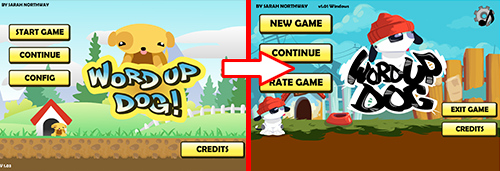
    Word Up Dog‘s coming to mobile this Thursday! Now for the very few of you who actually played the original Flash version (available here), I’m gonna tell you bout the changes I made. The most obvious one was the addition of Sara Gross of Two Bit Art to the team. She turned my janky blobbish characters into super pimpin funkmasters. By comparison anyway.

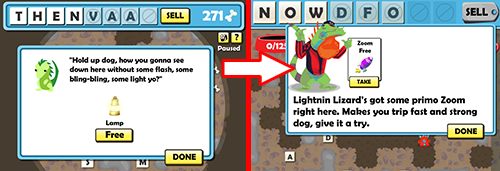
    The Lightnin (formerly Lamp) Lizard got some serious mojo.

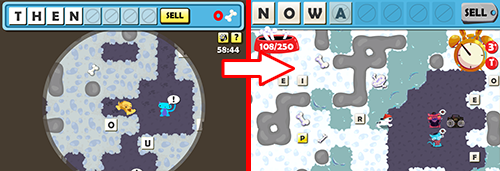
    I resisted change in the UI but added a sweet clock for the bonuses, and generally made everything bigger so it’d be easier to see and read on bitty little phone screens. I changed the default aspect ratio from 4:3 (800×600) to 16:9 (iPhone5), but the game stretches and pads to fit any device.

    The Dog left pastel country fields and donned a phat tuque.

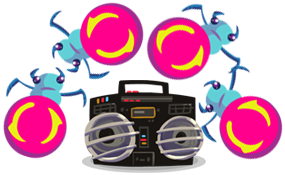
    Gameplay-wise I took out the idea of lamps and limited sight radius so you can see the whole screen all the time now. I added two more levels and a unique element to each one like vines, vending machines, dancing bugs and lava. And I took out adventure mode, which was a single superlong level that changed the deeper you went. It really needed some design work although it was my favorite way to play, and I’ll put it back in if I get enough mobile sales.

    You can see a lot more in the game now.

    The bulk of my time on this was spent totally rewriting the graphics engine in Stage3d/Starling and making a hundred other little performance improvements. Those things you don’t even have to think about when writing a browser game for PCs but suddenly become make-or-break on an iPad 1.

    The mobile version of Word Up Dog is so improved it’s practically a sequel, but I think of it as version 1.5. I’d like to go back and upgrade the original Flash version now… but ironically it runs slower now on some computers because of the Stage3d. The dance continues!

  • Word Up Dog: Bling-bling yo

    There are 7 levels in the new improved mobile Word Up Dog, each with it’s own bling-bling in the form of growing vines, dancing bugs, lava, ice and letter-spewing fire-hydrant shaped gashapon machines.

    Some things like the gashapon make life easier – you can feed it letters to exchange for different letters. Others are challenges to be overcome, like the vines that take as much energy to dig through as regular dirt, but grow back after a few minutes.

    When I wrote the original Word Up Dog two years ago, I was planning to make it a free mobile game with in-app purchases. You’d pay to unlock levels 2-7, and maybe to buy powerups and wildcards. I like demos and want as many people as possible to be able to play my games, but it seems that indie games are getting burned by free-to-play lately. I’ve decided I’m better off charging $1.99 to start and having halfprice sales as often as I can.